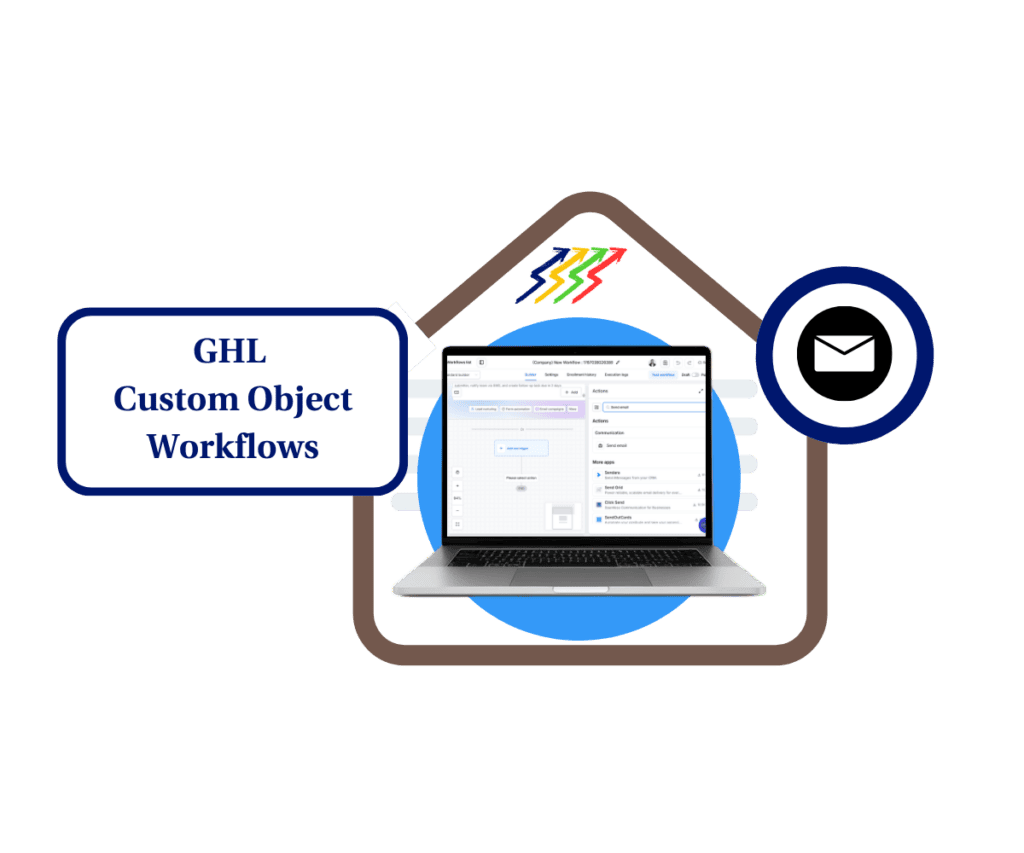
- Custom Object Workflows Make Automated Emails Easier
- Quick Summary – Custom Object Workflows
- Here are this week's HighLevel Updates 🚀
- Custom Object Workflows Can Now Send Emails
- Why Custom Object Workflows Matter for Your Business
- How to Use Email Actions in Custom Object Workflows
- Pro Tips for Custom Object Workflows
- What Custom Object Workflows Mean for Your Business
- FAQs Custom Object Workflows
- Custom Object Workflows Make Email Automation Easier
Custom Object Workflows Make Automated Emails Easier
Custom Object Workflows just became a lot more useful in GoHighLevel. You can now send automated emails from Company and Custom Object workflows directly to the contacts associated with those records.
Company and Custom Object workflows already give agencies more ways to build automations around how a business actually operates. But there’s been a catch. What happens when the workflow needs to send an email to a person connected to that Company or Custom Object?
Previously, GHL limited workflow email actions to Contact workflows. That meant you could have the right Company or Custom Object triggering the automation but still need additional workflow logic to get an email to the right person.
That’s where the new Send Email action comes in.
Open a Company or Custom Object workflow, add the Send Email action, and you can now use association labels to identify which associated contacts should receive the message. You can select up to 10 association labels within a single email action.
Custom Object Workflows give you even more control. You can choose to send the email to the earliest associated contact, most recently associated contact, or all associated contacts.
And you don’t need to worry about sending the same person multiple copies just because they match more than one selected association label. GHL will send that contact only one email from the action.
Custom Object Workflows now give GHL users a cleaner way to connect object-based automation with real customer communication. You can let the Company or Custom Object drive the process while automatically reaching the people associated with it.
For agencies building more advanced client systems, that’s a useful improvement. Your team can spend less time creating extra workflow logic just to send an email and more time building automations around the actual business process.
The latest GoHighLevel Changelog includes several other GHL feature updates that round out your daily workflow:
- Wait Action Enhancement: TikTok DM Replies
- India Recurring Mandate Support for Affiliate Indian Signup Pages
- Housecall Pro – More Workflow Actions & Triggers
- Email Services Dashboard for Agencies
- Email Sequences Now Available in Beta Labs
- Group Your Contacts by Source in Dashboards & Reporting
- MMLite Adoption Banner in Conversations
Keep reading for much more on all these updates and a deep dive into the Custom Object Workflows feature!
Quick Summary – Custom Object Workflows
Purpose: This GHL update lets you send automated emails directly from Company and Custom Object Workflows to associated contacts.
Why It Matters: You can build automation around the Company or Custom Object that drives the process instead of creating extra Contact workflows just to send an email.
What You Get: You can select association labels, target up to 10 association labels in one email action, and choose which associated contacts should receive the message.
Time to Complete: Allow about 5–10 minutes to enable the feature in Labs and add your first Send Email action to an existing workflow.
Difficulty Level: Beginner to Intermediate. The email action is straightforward, but understanding your association labels will help you target the right contacts.
Key Outcome: Custom Object Workflows can handle more of your business process from one automation, helping you reduce extra workflow logic while keeping email communication connected to the right records and contacts.
Here are this week’s HighLevel Updates 🚀
Wait Action Enhancement: TikTok DM Replies
What’s New:
Instead of continuing after a fixed delay, your workflow can pause until someone replies to your TikTok DM.
Where in GHL:
Found in Automation → Workflows using the Wait action after sending a TikTok DM.
Automate marketing, manage leads, and grow faster with GoHighLevel.
Impact:
Your automation responds when someone actually joins the conversation, rather than after a timer runs out.
Recommended For:
Anyone using TikTok DMs to start conversations with potential customers.
India Recurring Mandate Support for Affiliate Indian Signup Pages
What’s New:
Supports recurring payment mandates for Indian affiliates, helping subscriptions comply with local banking requirements.
Where in GHL:
Available on Affiliate Program signup pages for users in India.
Impact:
Creates a smoother signup experience while reducing payment failures for recurring subscriptions.
Recommended For:
Agencies, SaaS businesses, and affiliate programs onboarding customers in India.
Housecall Pro – More Workflow Actions & Triggers
What’s New:
Adds new workflow triggers and actions for the Housecall Pro integration, giving you more ways to automate field service processes.
Where in GHL:
Inside Automation → Workflows when using the Housecall Pro integration.
Impact:
Expands automation possibilities between HighLevel and Housecall Pro, reducing manual work and improving operational efficiency.
Recommended For:
Home service businesses, field service companies, and agencies managing Housecall Pro clients.
Email Services Dashboard for Agencies
What’s New:
Introduces a centralized dashboard where agencies can monitor email services across their accounts.
Where in GHL:
Found in the Agency View under the new Email Services Dashboard.
Impact:
Makes it easier to monitor email health, identify issues, and manage deliverability from one place.
Recommended For:
Agency owners, support teams, and admins managing multiple client email services.
Email Sequences Now Available in Beta Labs
What’s New:
Introduces Email Sequences as a Beta Labs feature, providing another way to create structured email follow-up campaigns.
Where in GHL:
Enable it from Settings → Labs, then access Email Sequences after activation.
Impact:
Cuts down the time spent checking different areas just to see how your email services are performing.
Recommended For:
Marketers, agencies, coaches, and businesses running nurture campaigns or onboarding emails.
Group Your Contacts by Source in Dashboards & Reporting
What’s New:
Lets you organize contact reports based on where your leads originated.
Where in GHL:
Available within Dashboards & Reporting when viewing contact analytics.
Impact:
Makes it easier to compare lead sources and identify which marketing channels are producing the best results.
Recommended For:
Marketing teams, agency owners, and businesses tracking campaign performance across multiple lead sources.
MMLite Adoption Banner in Conversations
What’s New:
Displays a helpful banner inside Conversations to encourage users to adopt the new MMLite messaging experience.
Where in GHL:
Appears within the Conversations module for eligible accounts.
Impact:
Helps users discover and transition to MMLite while highlighting its benefits directly inside the messaging interface.
Recommended For:
Current HighLevel users exploring the latest messaging experience and teams preparing to migrate to MMLite.
Custom Object Workflows Can Now Send Emails
Custom Object Workflows can now do something that was previously limited to Contact workflows in GoHighLevel: send automated emails.
Before this update, the Send Email workflow action wasn’t available when your automation was built around a Company or Custom Object. That limited what you could do when the record driving the automation wasn’t an individual contact.
GHL has now expanded the Send Email action to both Company workflows and Custom Object workflows.
The important part is how GHL handles the recipient.
Instead of making you build additional automation just to find the right person, you can select association labels inside the Send Email action. Those labels tell GHL which contacts associated with the Company or Custom Object should receive the message.
You can select up to 10 association labels for a single email action. If the same contact matches more than one of those labels, GHL only sends that person one email.
With Custom Object Workflows, you can decide exactly who gets the email. Send it to the first contact associated with the record, the latest one added, or everyone connected to it.
That extra control is what makes this update useful.
You can build the automation around the record that actually matters to the process, then use its existing contact relationships to handle the communication.
One important detail before you start: emails sent through this action use the domain configured for Bulk Email. We’ll cover the setup and recipient options step by step later in this guide.
Why Custom Object Workflows Matter for Your Business
Custom Object Workflows become much more powerful when the automation can communicate with the people connected to the record. Instead of pushing everything through a Contact workflow, you can build the automation around the Company or Custom Object that actually drives the process.
Think about a marketing agency managing client projects. You could create a Custom Object for each project and associate the right client contacts with it. When something changes with that project, the workflow can automatically send an email to the appropriate associated contacts.
The same idea can work for many different business processes.
You could use Custom Object Workflows for properties, service jobs, applications, subscriptions, vendors, projects, or other records that don’t fit neatly into a standard Contact or Opportunity.
Company workflows also become more useful for B2B automation. Instead of treating every person at a business as a separate process, the Company can drive the workflow while association labels help determine which people should receive the email.
That can mean fewer workarounds and cleaner automations.
For agencies, the bigger benefit is flexibility. You can build GHL around the way a client’s business works instead of forcing every automation to start and finish with an individual contact.
And because you can choose specific association labels, you have more control over who gets each message. That helps you keep automated communication relevant without creating extra workflow branches just to reach the right person.
Custom Object Workflows aren’t just getting another action. They’re becoming a more practical way to automate complete business processes inside GoHighLevel.
How to Use Email Actions in Custom Object Workflows
Custom Object Workflows can now send emails directly to associated contacts, but you’ll need to enable the feature in Labs first. From there, the setup happens inside your Company or Custom Object workflow.
You’ll choose the association labels that identify who should receive the email, create your message, and publish the workflow. Custom Object workflows also let you decide whether GHL should email the earliest, most recent, or all associated contacts.
Before starting Enable Email Actions in Labs, go to the left-hand sidebar and look all the way to the bottom. Click the gear icon labeled “Settings.” Navigate to “Labs.” Find “Email Action in Company & Custom Object Workflows.” and enable.
- Open Your Workflow in GHL.
- Add the Send Email Action.
- Choose Your Associated Contacts.
- Create Your Email in Workflow.
- Save and Publish Your Workflow.
To start, make sure you are logged in to your GoHighLevel sub-account.
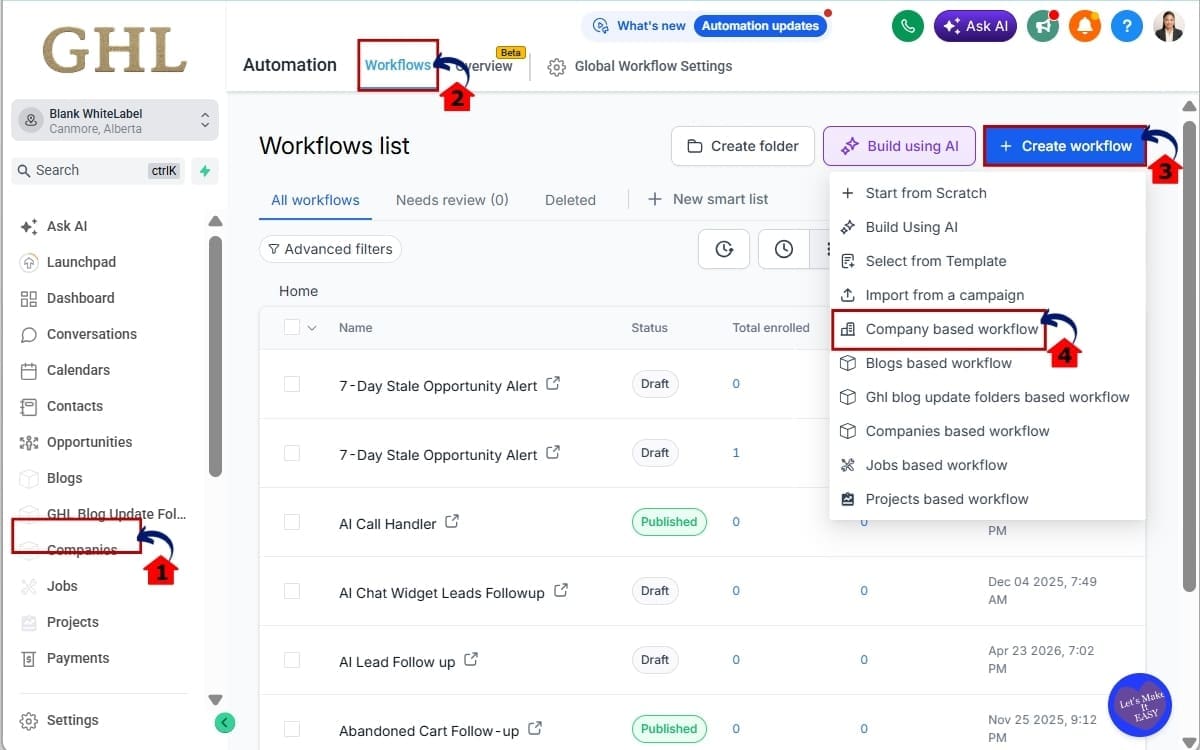
Step 01 – Open Your Workflow in GHL
- Start by opening the workflow area where you’ll create your Company-based workflow.
1.1 Click Automation in your GHL sub-account.
- You’ll find Automation in the main left-hand menu of your sub-account.
1.2 Open Workflows in the submenu.
- This takes you to the area where you can view, create, and manage your workflows.
1.3 Click + Create Workflow.
- This opens the options for creating a new workflow in GHL.
1.4 Click Company Based Workflow.
- This creates a workflow that runs around Company records rather than individual Contact records.
Step 02 – Add the Send Email Action
- Now you’ll add the email action that lets your Company workflow automatically send a message to associated contacts.
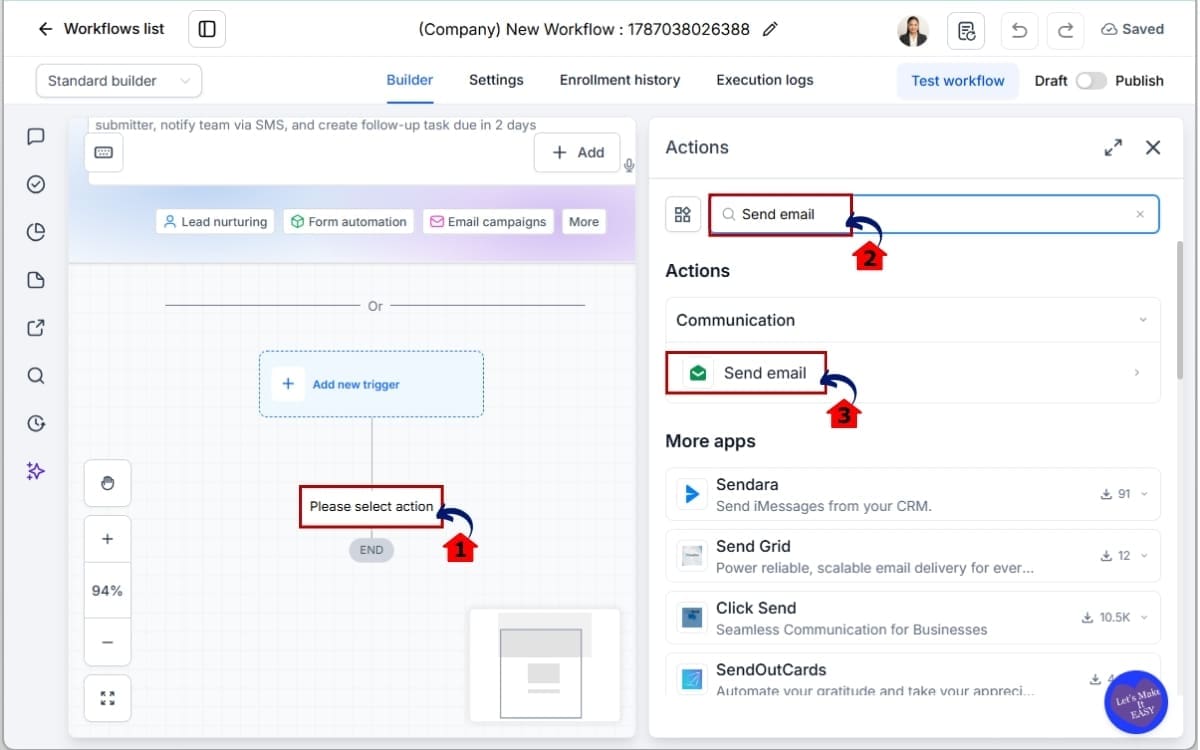
2.1 Click “Add Action” at the appropriate point in your workflow.
- Choose where you want the automated email to be sent within the workflow sequence.
2.2 Search for “Send Email.”
- Use the action search box to quickly find the email option.
2.3 Select the “Send Email” action.
- This opens the email settings where you can choose the associated contacts who should receive your message.
Step 03 – Choose Your Associated Contacts
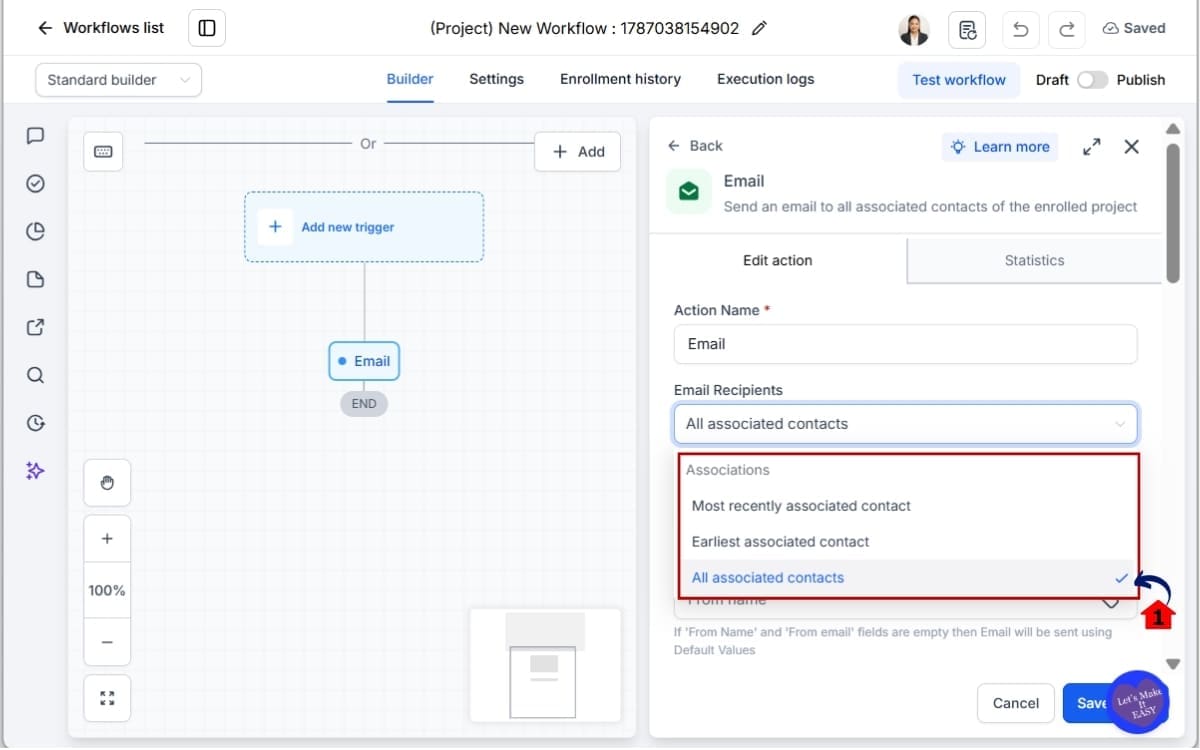
- Select the association label or labels that identify the contacts you want to email.
3.1 If you’re working with Custom Object Workflows, choose how GHL should select the associated contact:
- Earliest associated contact – Send the email to the earliest associated contact.
- Most recently associated contact – Send it to the most recently associated contact.
- All associated contacts – Send it to all contacts that match your selected associations.
Step 04 – Create Your Email in Workflow
- Now you can create the email that will be automatically sent to your selected associated contacts.
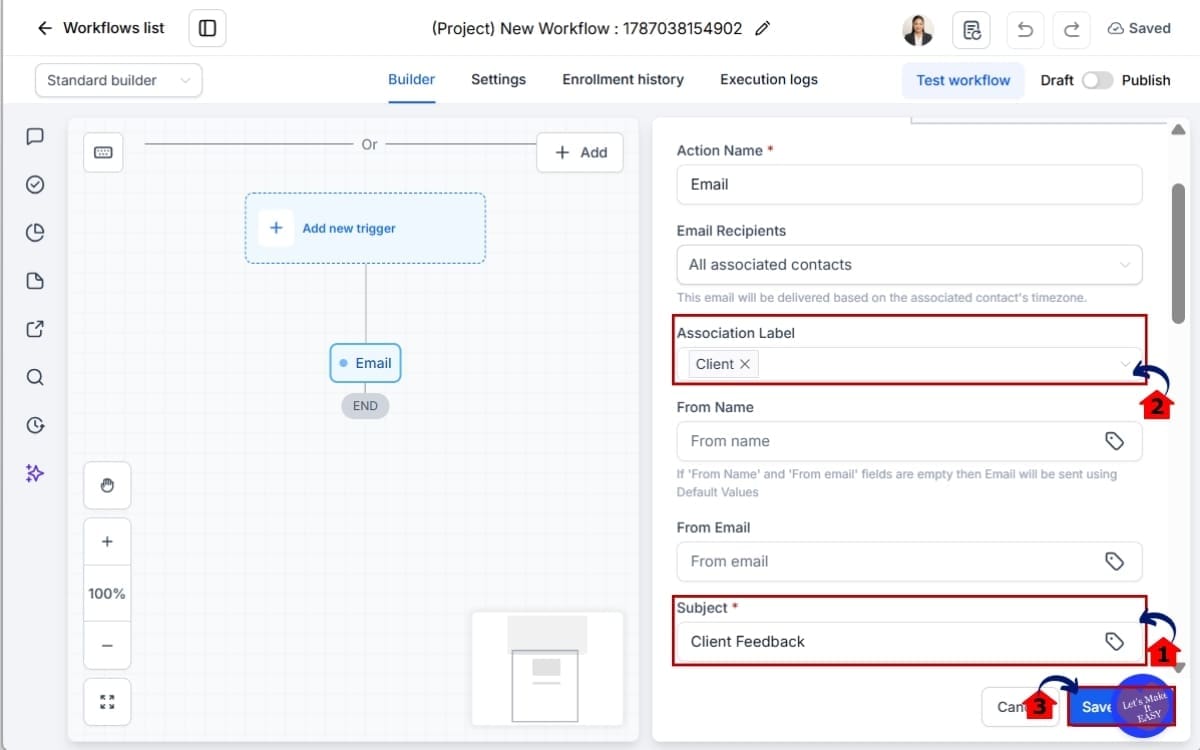
4.1 Enter the subject line for your email.
- Add a clear subject line that tells the recipient what the email is about.
4.2 Add the email content you want your associated contacts to receive.
- Write your message and include any important information, links, or next steps the recipient needs.
4.3 Click “Save.”
- This saves your Send Email action and adds it to your workflow.
Review your recipient settings and email content before saving. Remember that these emails are sent using the domain configured for Bulk Email. If you’re setting this up for a client, check that configuration before putting the automation into use.
Step 05 – Save and Publish Your Workflow
- Before going live, give your workflow one final check to make sure the Send Email action is in the right place.
5.1 Review the workflow and make sure the action is positioned where you want the email to be sent.
- Check the steps before and after the Send Email action to confirm the email will be triggered at the right point in your automation.
5.2 Save and publish your workflow.
- Once everything looks right, publish the workflow so it can start running when the required workflow conditions are met.
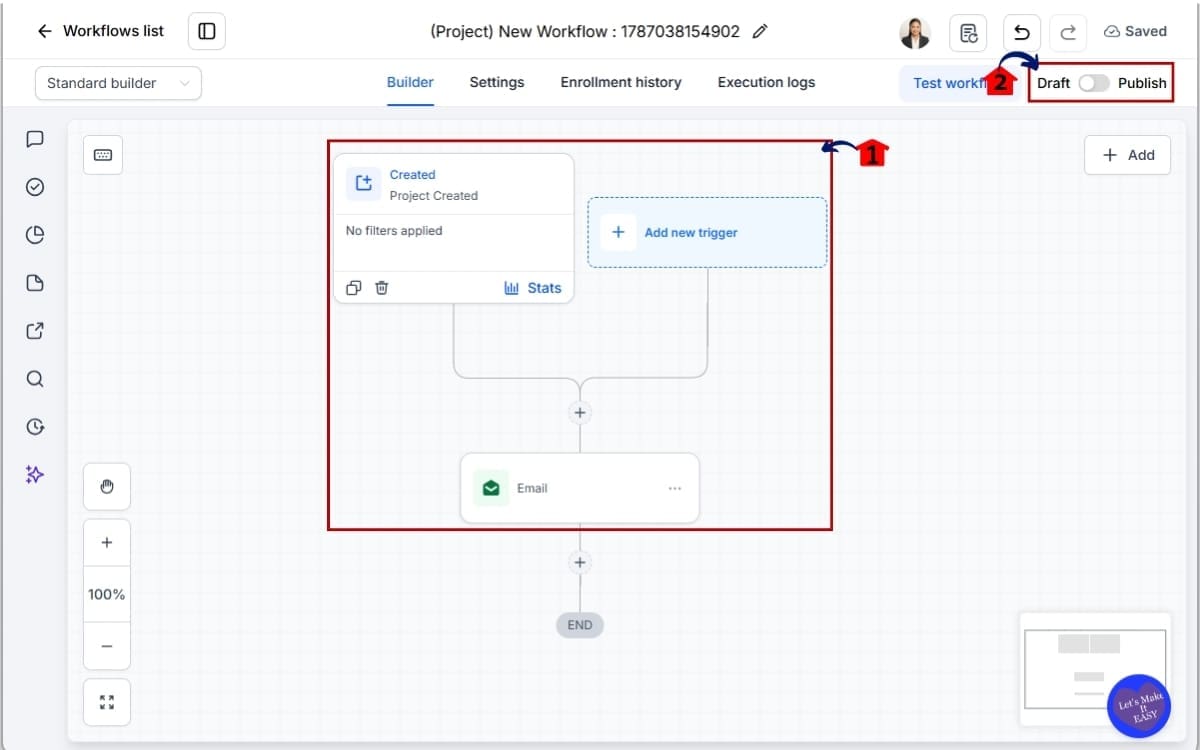
That’s it. Your Company or Custom Object workflow can now automatically email the associated contacts you selected without needing another workflow just to handle the message.
Pro Tips for Custom Object Workflows
Custom Object Workflows can save you from building extra automation just to get an email to the right person. But before you start adding Send Email actions everywhere, a little planning will keep those workflows cleaner and easier to manage.
Start with your association labels. Use labels that make it obvious how each contact relates to the Company or Custom Object. When you come back to the workflow months later, you should be able to understand why each group is receiving the email without having to reverse-engineer your own setup.
Be careful with the “All associated contacts” option. It’s useful when everyone connected to the Custom Object needs the same update, but it shouldn’t be your default choice. Use the earliest or most recently associated contact when the business process only requires one person to receive the message.
You can also select up to 10 association labels in a single email action. That gives you flexibility without forcing you to create a separate Send Email action for every relationship.
And don’t worry if one person matches more than one of those selected labels. GHL will only send that contact one email from the action, helping you avoid duplicate messages.
Before publishing, check your Bulk Email domain. Emails from these workflows use the domain configured for Bulk Email, so this should be part of your setup checklist rather than something you discover after the workflow starts running.
Finally, test your Custom Object Workflows with a few sample records first. Check the associations, confirm the right contacts receive the email, and make sure your recipient selection works the way you expected.
A few minutes of testing can save you from explaining to a client why the wrong person just received an automated project update.
What Custom Object Workflows Mean for Your Business
Custom Object Workflows give agencies more freedom to build automation around the actual process being managed. Instead of creating extra Contact workflows just to send an email, the Company or Custom Object can stay at the center of the automation.
Imagine an agency builds a Custom Object called “Client Projects.” Each project record could have contacts associated with it based on their role in the project.
When the project reaches a certain point in the workflow, GHL can send an automated email to the associated contacts you select. That could be a project update, next-step notification, reminder, or another message connected to the process.
Company workflows can work in a similar way.
For example, a B2B business may have several contacts associated with the same Company. Rather than building separate automation around every individual contact, the Company can drive the workflow while association labels determine who receives the email.
That’s where this update can remove some unnecessary moving parts.
You can keep the workflow connected to the record that matters while still reaching the people who need the information. For agencies building more customized GHL systems, that can mean fewer workflow handoffs and a cleaner automation setup.
The real opportunity is to think beyond basic lead follow-up.
Custom Object Workflows can support business processes built around projects, services, applications, properties, vendors, or other records your clients need to manage. Now those processes can include automated email communication with the contacts associated with them.
That makes Custom Objects more practical for agencies that want to shape GoHighLevel around how a client’s business actually works.
FAQs Custom Object Workflows
Custom Object Workflows Make Email Automation Easier
Custom Object Workflows are becoming a much more practical part of GoHighLevel automation. With the Send Email action now available for Company and Custom Object workflows, you can communicate with associated contacts without routing everything through a separate Contact workflow.
The biggest advantage is control.
You can use association labels to decide which contacts should receive the message, select up to 10 labels in one email action, and avoid duplicate emails when the same contact matches multiple selected labels.
Custom Object Workflows also give you the choice of emailing the earliest associated contact, most recently associated contact, or all associated contacts. That makes it easier to match your email automation to the way each business process actually works.
For agencies, this opens up plenty of possibilities.
Projects, properties, applications, vendors, service jobs, and other custom business records can now drive both the automation and the communication connected to them. Company workflows can do the same for businesses that need to communicate with specific people associated with an account.
Just remember to enable the feature in Labs, check your association labels, and make sure your Bulk Email domain is configured before going live.
Then test it.
A simple test workflow will help you confirm that the right associated contacts receive the right message before you roll the automation out across a client account.
If you’re already using Companies or Custom Objects in GHL, this update is worth trying. It removes another layer of workflow setup and gives you more freedom to build automations around the way your clients actually do business.
Have you tried email actions in Custom Object Workflows yet? What business process are you planning to automate with them?
Scale Your Business Today.
Streamline your workflow with GoHighLevel’s powerful tools.