- AI Workflow Explanation Makes Snapshot Workflows Easier
- Quick Summary – AI Workflow Explanation
- Here are this week's HighLevel Updates 🚀
- What’s New With AI Workflow Explanation
- Why AI Workflow Explanation Matters for GHL Users
- How to Use AI Workflow Explanation Step by Step
- Quick Tips for Better AI Workflow Explanations
- What AI Workflow Explanation Means for Agencies
- Results You Can Expect From AI Workflow Explanation
- AI Workflow Explanation FAQs
- Conclusion – AI Workflow Explanation
AI Workflow Explanation Makes Snapshot Workflows Easier
AI Workflow Explanation just made working with imported automations in GoHighLevel a whole lot easier. You can now open a workflow brought in through a snapshot and quickly understand what it does without manually tracing every trigger, action, and branch.
Snapshot workflows can save agencies a ton of time. But there’s always been a catch. What happens when you import a workflow that somebody else built and have no idea why it was set up that way?
Maybe you don’t understand what starts the automation. Maybe there are several branches with different conditions. Or maybe you need to change an action but aren’t sure what else that change could affect.
That’s where the new AI Workflow Explanation feature comes in.
Open a workflow imported through a snapshot, and GHL now displays an “Explain This Workflow” pill at the top of the Workflow Builder. Click it, and the AI Assistant opens with a breakdown of the workflow.
No more opening every step and trying to piece together what the workflow is supposed to do. You can get the overall picture first, then ask the AI Assistant about any part that needs a closer look.
And you’re not stuck with just an explanation. If you spot something you want changed, tell the AI Assistant what you’d like instead and let AI Builder handle the edit.
AI Workflow Explanation gives GHL users a faster way to understand inherited snapshot workflows before they start editing them. You can review the automation, question its logic, and move from understanding the workflow to improving it from the same AI experience.
For agencies sharing snapshots across client accounts, that’s a useful improvement. Your team can spend less time figuring out how inherited automations work and more time adapting those workflows for the client or campaign in front of them.
The latest GoHighLevel Changelog includes several other GHL feature updates that round out your daily workflow:
- Wait Action Enhancement: TikTok DM Replies
- India Recurring Mandate Support for Affiliate Indian Signup Pages
- Housecall Pro – More Workflow Actions & Triggers
- Email Services Dashboard for Agencies
- Email Sequences Now Available in Beta Labs
- Group Your Contacts by Source in Dashboards & Reporting
- MMLite Adoption Banner in Conversations
Keep reading for much more on all these updates and a deep dive into the AI Workflow Explanation History feature!

Quick Summary – AI Workflow Explanation
Purpose: AI Workflow Explanation helps GHL users quickly understand workflows imported through snapshots by using the AI Assistant to explain how the automation works.
Why It Matters: Snapshot workflows are often inherited rather than built by the person managing them. This feature makes it easier to understand triggers, actions, and branching logic before making changes.
What You Get: You get a one-click AI explanation of an imported workflow, the ability to ask follow-up questions about specific steps, and a direct path to requesting changes through AI Builder.
Time to Complete: You can generate the initial workflow explanation in seconds, while reviewing complex workflows and asking follow-up questions may take a few extra minutes.
Difficulty Level: Beginner-friendly. If you can open a workflow inside GHL, you can use the “Explain This Workflow” feature without any special setup.
Key Outcome: You can understand inherited snapshot automations faster, make more informed changes, and spend less time manually tracing workflow logic.
Here are this week’s HighLevel Updates 🚀
Wait Action Enhancement: TikTok DM Replies
What’s New:
Instead of continuing after a fixed delay, your workflow can pause until someone replies to your TikTok DM.
Where in GHL:
Found in Automation → Workflows using the Wait action after sending a TikTok DM.
Automate marketing, manage leads, and grow faster with GoHighLevel.
Impact:
Your automation responds when someone actually joins the conversation, rather than after a timer runs out.
Recommended For:
Anyone using TikTok DMs to start conversations with potential customers.
India Recurring Mandate Support for Affiliate Indian Signup Pages
What’s New:
Supports recurring payment mandates for Indian affiliates, helping subscriptions comply with local banking requirements.
Where in GHL:
Available on Affiliate Program signup pages for users in India.
Impact:
Creates a smoother signup experience while reducing payment failures for recurring subscriptions.
Recommended For:
Agencies, SaaS businesses, and affiliate programs onboarding customers in India.
Housecall Pro – More Workflow Actions & Triggers
What’s New:
Adds new workflow triggers and actions for the Housecall Pro integration, giving you more ways to automate field service processes.
Where in GHL:
Inside Automation → Workflows when using the Housecall Pro integration.
Impact:
Expands automation possibilities between HighLevel and Housecall Pro, reducing manual work and improving operational efficiency.
Recommended For:
Home service businesses, field service companies, and agencies managing Housecall Pro clients.
Email Services Dashboard for Agencies
What’s New:
Introduces a centralized dashboard where agencies can monitor email services across their accounts.
Where in GHL:
Found in the Agency View under the new Email Services Dashboard.
Impact:
Makes it easier to monitor email health, identify issues, and manage deliverability from one place.
Recommended For:
Agency owners, support teams, and admins managing multiple client email services.
Email Sequences Now Available in Beta Labs
What’s New:
Introduces Email Sequences as a Beta Labs feature, providing another way to create structured email follow-up campaigns.
Where in GHL:
Enable it from Settings → Labs, then access Email Sequences after activation.
Impact:
Cuts down the time spent checking different areas just to see how your email services are performing.
Recommended For:
Marketers, agencies, coaches, and businesses running nurture campaigns or onboarding emails.
Group Your Contacts by Source in Dashboards & Reporting
What’s New:
Lets you organize contact reports based on where your leads originated.
Where in GHL:
Available within Dashboards & Reporting when viewing contact analytics.
Impact:
Makes it easier to compare lead sources and identify which marketing channels are producing the best results.
Recommended For:
Marketing teams, agency owners, and businesses tracking campaign performance across multiple lead sources.
MMLite Adoption Banner in Conversations
What’s New:
Displays a helpful banner inside Conversations to encourage users to adopt the new MMLite messaging experience.
Where in GHL:
Appears within the Conversations module for eligible accounts.
Impact:
Helps users discover and transition to MMLite while highlighting its benefits directly inside the messaging interface.
Recommended For:
Current HighLevel users exploring the latest messaging experience and teams preparing to migrate to MMLite.
What’s New With AI Workflow Explanation
AI Workflow Explanation adds a new way to understand workflows that arrive in your GHL sub-account through a snapshot. Instead of opening an unfamiliar automation and working through it piece by piece, you can now ask AI to explain the workflow from inside the builder.
The biggest change is the new “Explain This Workflow” pill. It appears at the top of workflows that have been imported through a snapshot, putting the explanation option right where you need it.
Click the pill, and GoHighLevel opens the AI Assistant. It then provides a breakdown of the workflow’s triggers, actions, and branching logic. This gives you a clearer picture of what starts the workflow, what happens as a contact moves through it, and how different paths affect the automation.
You’re not limited to the first AI Workflow Explanation either. If a trigger, action, or branch doesn’t make sense, you can ask follow-up questions in the AI Assistant. You can also describe changes you want to make and use AI Builder to help apply them.
Once you understand the workflow and no longer need the prompt, you can dismiss the “Explain This Workflow” pill. After you dismiss it, the pill won’t appear again on that workflow.
It’s a small addition to the Workflow Builder, but it connects three useful parts of GHL: snapshot workflows, the AI Assistant, and AI Builder. Instead of simply inheriting an automation, you now have a quicker path to understanding why it works and deciding what you want to do with it next.
Why AI Workflow Explanation Matters for GHL Users
Snapshot workflows are great for moving automations from one account to another. The tricky part comes when you open one and realize you have no clue why it was built that way.
It gets trickier when you’re dealing with a workflow that has a lot going on. Triggers lead into waits, messages, tags, and If/Else paths. Before touching anything, it helps to know what depends on what.
For agencies, this becomes even more important when several people work inside the same GHL account. A workflow might have been created by another team member, purchased as part of a snapshot, or imported months ago. The person opening it today may have no background on how it works.
Instead of playing detective every time you inherit a workflow, you can get some context right away. From there, ask the AI Assistant about whatever still looks confusing.
This could be handy when someone new joins the team. Your VA or marketer doesn’t have to track down whoever built the workflow just to find out what’s going on. They can open it in GHL and start getting answers right there.
Jumping straight into edits on a workflow you barely know is asking for trouble. Get the story first. Once you know what each part is doing, you can give AI Builder much clearer instructions about what should change.
For agencies using snapshots to deploy repeatable systems across client accounts, that creates a smoother handoff. Import the automation, understand how it works, ask questions, and then adapt it for the client in front of you.
How to Use AI Workflow Explanation Step by Step
Using AI Workflow Explanation is simple because GHL puts the feature directly inside eligible snapshot workflows. You don’t need to turn on a separate setting or leave the Workflow Builder to get started.
The process starts by opening a workflow that was imported through a snapshot. From there, you can ask the AI Assistant to explain the automation, dig deeper with follow-up questions, and even describe changes you want AI Builder to make.
- Access Workflows in GoHighLevel.
- Open Your Imported Snapshot Workflow.
- Generate Your AI Workflow Explanation.
- Check the Explanation in AI Assistant.
- Ask Follow-Up Questions.
To start, make sure you’re logged in to the correct GoHighLevel sub-account.
Step 01 – Access Workflows in GoHighLevel
- Start in the Automation area where GHL keeps your workflows and other automation tools.
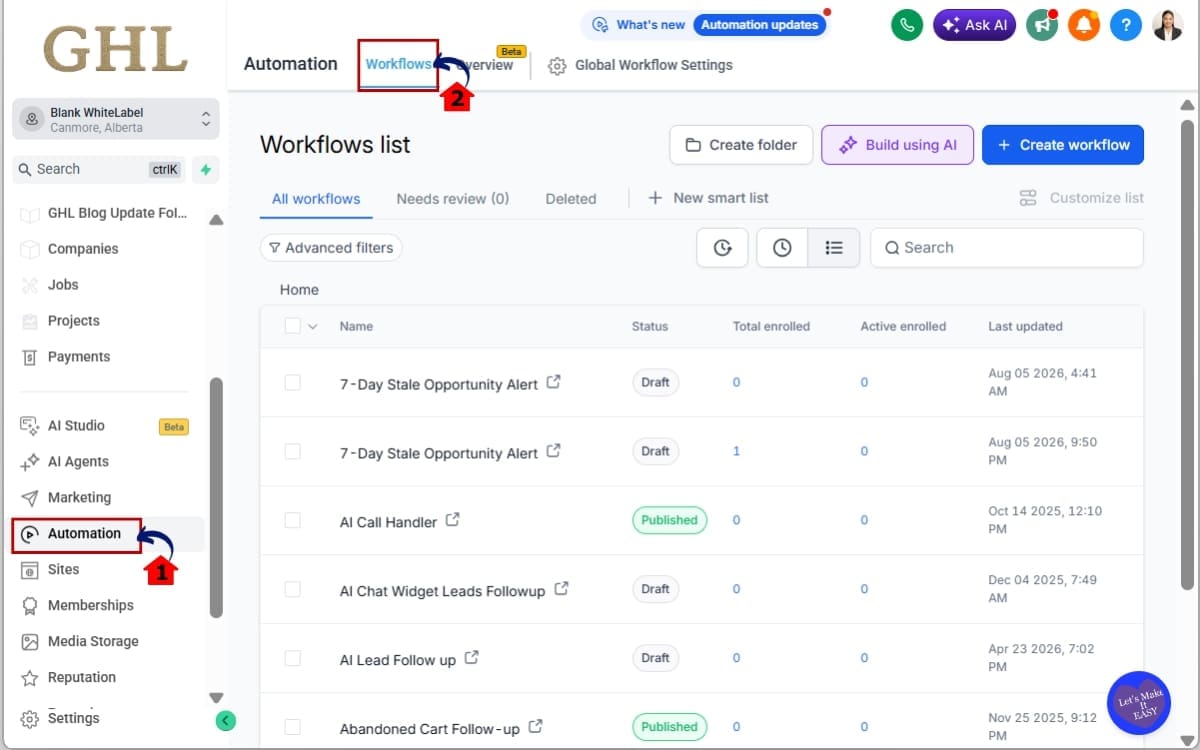
1.1 Go to the main menu on the left side of your screen. Click “Automation” to access the workflow area of GHL.
- This opens the section where you can view and manage the automations inside your sub-account.
1.2 Open the “Workflows” section and locate the workflow you want to review.
- Look for the workflow that came into the account through the snapshot and that you want GHL’s AI Assistant to explain.
Step 02 – Open Your Imported Snapshot Workflow
- The AI Workflow Explanation prompt is designed for workflows brought into your GHL account through a snapshot.
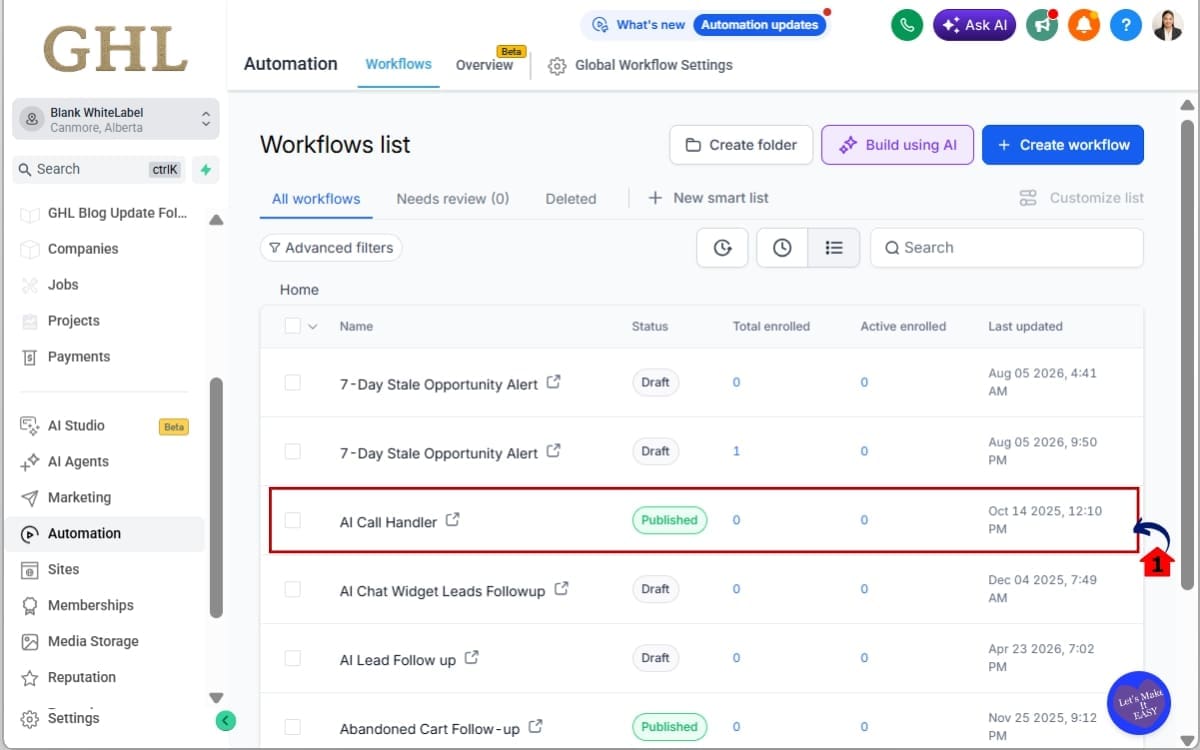
2.1 Find the workflow that was imported through your snapshot. Click the workflow to open it in the Workflow Builder.
- Once the builder opens, you’ll be able to view the full automation and access the new AI explanation option.
Step 03 – Generate Your AI Workflow Explanation
- Now you can use GHL’s AI Assistant to break down the imported automation and help you understand how it works.
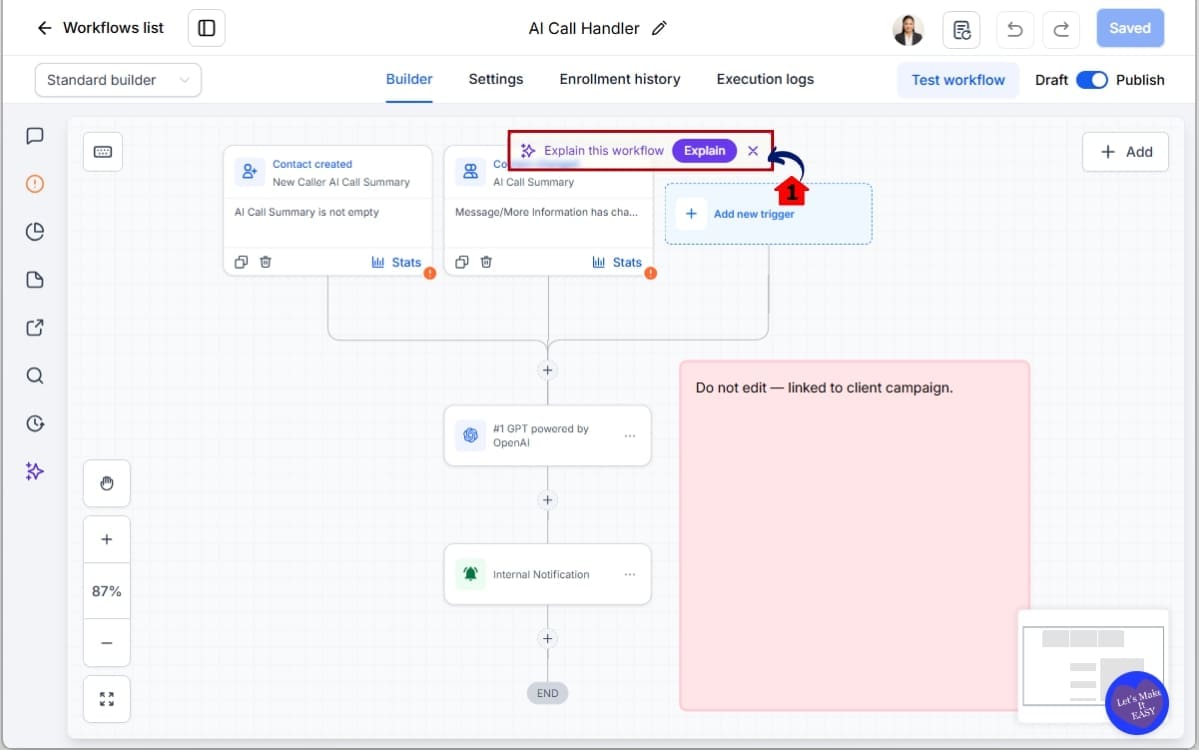
3.1 Click the “Explain This Workflow” pill.
- This opens the AI Assistant, where GHL will generate an explanation of the workflow’s triggers, actions, and branching logic.
Step 04 – Check the Explanation in AI Assistant
- Once the AI Assistant opens, take a moment to read through its explanation and get a clearer picture of how the workflow operates.
4.1 The AI Assistant will open with an explanation of the workflow.
- The explanation gives you an overview of what the imported automation is designed to do and how its main pieces fit together.

Step 05 – Ask Follow-Up Questions
- This is where the feature becomes more useful than a basic workflow summary.
5.1 Ask why a specific condition if its purpose isn’t clear.
- For example, you might ask the AI Assistant to explain what happens when a contact fails to meet a particular branch condition.
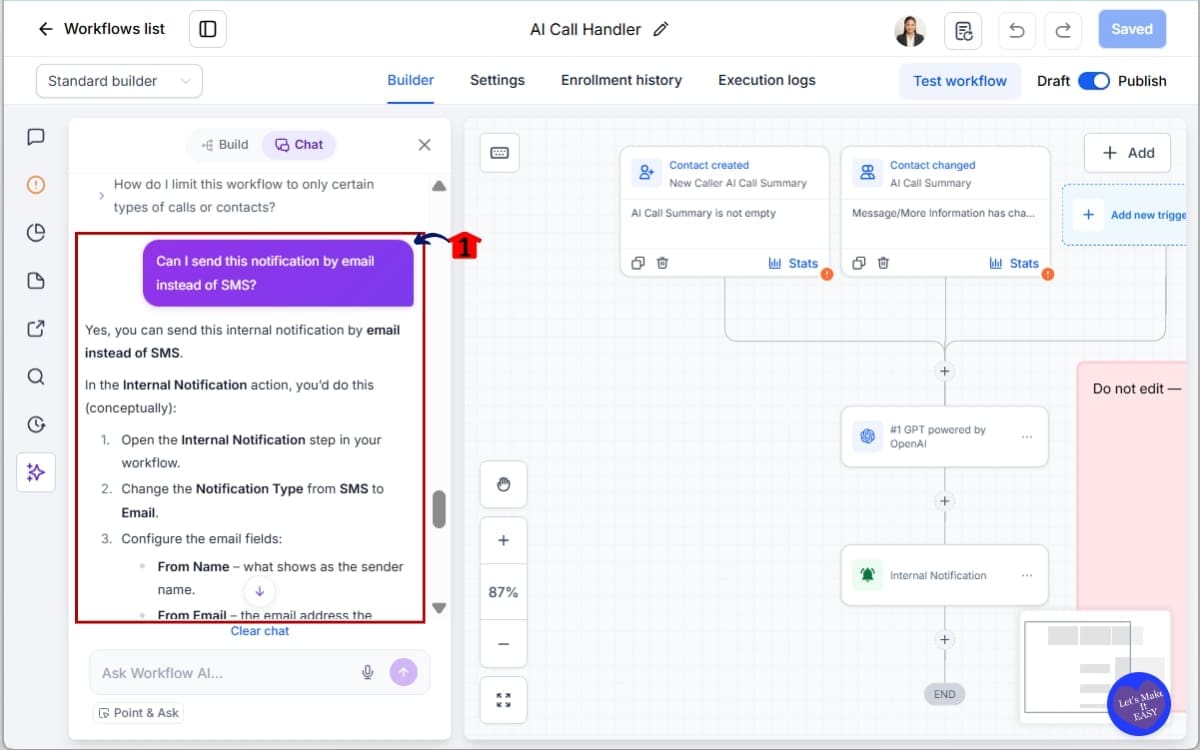
If you’re still learning automation, there’s no need to rush this step. Use the AI Workflow Explanation and follow-up questions until you’re comfortable with how the imported workflow operates.
Quick Tips for Better AI Workflow Explanations
AI Workflow Explanation can give you the big picture fast, but don’t stop at the first explanation. The real value comes from using the AI Assistant to dig into the parts of the automation that matter most.
Start with specific questions. If a workflow has several branches, ask what causes a contact to enter each path. If an action looks unnecessary, ask what role it plays before you remove it. This is much more useful than simply asking AI to explain the entire workflow again.
For agencies, make AI Workflow Explanation part of your snapshot review process. When a team member imports an unfamiliar snapshot, have them review the explanation before they start editing. This can be especially helpful for VAs, new staff, or anyone taking over automations built by somebody else.
You might understand most of the workflow right away but get stuck on one odd-looking step. That’s fine. Ask the AI Assistant about that step specifically and work from there.
Once you know how the workflow works, you can describe the changes you want and let AI Builder help apply them. Just make sure you review those changes before relying on the updated automation. AI can speed up the work, but you should still confirm that the workflow does what you intended.
Finally, don’t dismiss the “Explain This Workflow” pill too quickly. GHL states that once you dismiss it, it won’t reappear on that workflow. If you’re still learning the automation, keep it available until you’re comfortable with the setup.
Used this way, AI Workflow Explanation becomes more than a quick summary. It gives your team a practical starting point for understanding, questioning, and improving inherited GHL automations.
What AI Workflow Explanation Means for Agencies
AI Workflow Explanation could be especially useful for agencies that rely on snapshots to roll out automations across multiple GHL sub-accounts. The workflow can be imported in seconds, but understanding everything inside it has traditionally taken more time.
Think about onboarding a new client. You import your agency snapshot with lead follow-up workflows, appointment reminders, pipeline automations, and other systems already built. A team member opens one of those workflows later but wasn’t involved when the original automation was created.
Instead of asking the original builder to explain it or manually tracing every path, they can use AI Workflow Explanation as their starting point. The AI Assistant can break down the triggers, actions, and branching logic so they have context before making changes.
That can also help when customizing snapshot workflows for different clients. Your core automation might stay the same, while individual clients need different messages, timing, actions, or workflow logic. Your team can first understand the imported version and then tell AI Builder what needs to change.
There’s also a useful onboarding angle here. New employees, VAs, contractors, and account managers often inherit automations they didn’t build. Giving them a way to question the workflow directly inside GHL could reduce some of the back-and-forth required to understand how the automation is supposed to work.
This doesn’t mean agencies should stop documenting important automations. AI Workflow Explanation is better viewed as another layer of context available at the exact moment someone needs it.
For agencies, that’s the bigger opportunity. Snapshots already make automation easier to distribute. Now GHL is making those inherited workflows easier to understand, question, and edit after they arrive in the client account.
Results You Can Expect From AI Workflow Explanation
AI Workflow Explanation should help you spend less time figuring out inherited automations and more time actually working with them. Instead of starting with a blank understanding of a snapshot workflow, you can start with a breakdown of what it does.
The first benefit is speed. You can use the AI Assistant to understand the triggers, actions, and branching logic without manually tracing every possible path through the workflow.
It’s a lot easier to make the right call when you know why the workflow was put together that way in the first place. That’s especially true with snapshot automations or anything handed over by another team member. Some steps may be there for a very good reason.
For agency teams, the feature can also make workflow handoffs easier. A VA, account manager, or new team member can use AI Workflow Explanation to get familiar with an inherited automation and then ask follow-up questions about specific steps.
The biggest improvement, though, is what happens next.
Once the workflow makes sense, you can stop studying it and start working on it. Tell the AI Assistant what you’d like done differently, and AI Builder can help turn those ideas into actual changes.
The end result is simple: less time asking, “What does this workflow do?” and a faster path to adapting the automation for the client, campaign, or process you’re working on.
AI Workflow Explanation FAQs
Conclusion – AI Workflow Explanation
AI Workflow Explanation takes some of the guesswork out of working with snapshot automations in GoHighLevel. Instead of opening an inherited workflow and trying to figure out every trigger, action, and branch yourself, you can ask GHL’s AI Assistant to break it down for you.
That makes the feature especially useful for agencies. Snapshots are great for moving proven systems between sub-accounts, but the person importing or managing the workflow isn’t always the person who originally built it.
Now, there’s a quicker way to close that knowledge gap.
Start by opening the snapshot workflow and hitting “Explain This Workflow.” Let GHL give you the rundown, then dig into anything that still doesn’t make sense. Once you’ve got your head around it, tell AI Builder what you’d like done differently.
It’s a simple update, but it improves the entire snapshot workflow process. You’re not just importing an automation anymore. You have a built-in way to understand it, question it, and start adapting it for the account you’re working on.
If your agency regularly installs snapshots across client accounts, try AI Workflow Explanation the next time you open an inherited workflow. It could save your team from spending valuable time manually picking apart an automation just to understand what’s going on.
Have you tried the new “Explain This Workflow” feature yet? Would you use it to help your team understand and customize snapshot automations faster?
Scale Your Business Today.
Streamline your workflow with GoHighLevel’s powerful tools.